Thursday, December 6, 2012

GRANDMA'S LITTLE POOL SHARK


That's my granddaughter Taylor in the picture above. And yes, she's tending bar. I figure it's never to early to learn a trade. Never know when she's going to have to get out and earn a living.


And this is my wife Kathy. She's on the other side of the bar, actively engaged in the work training process. There's nothing she won't do for that girl..no sacrifice she won't make. I love that woman!


Now, this is Taylor's favorite playground. She's absolutely obsessed with shootin' pool. What the hell..if tending bar doesn't work out she can always hustle a few games. And that's my wife Kathy in the picture, sinking the eight ball for the win. 

I'm surrounded by bad, bad women.


This is Taylor's Christmas present. A nice little 48" two piece cue with it's own carry case. She shoots pool at the Eagles every other Friday night. She's gonna look pretty awesome when she walks in with this!

Some kids play football, some play soccer. In our family we specialize in the more sophisticated sports, the ones that generally require a smoky room and the smell of old men and beer.

Somebody has to keep the traditions alive.

Wednesday, December 5, 2012

DIGITAL MODE AND NBEMS - BASIC HOW-TO

To follow up on the previous post:

These videos cover the basics of getting your station set up for digital broadcasting using the FLDIGI software and the Narrow Band Emergency Message system. NBEMS is widely used in ARES. These videos cover pretty much what you need to know.

Now, all you have to do is get involved in your local ARES group and start using them.

The software that you need to install FLDIGI can be found HERE.

The software for CHECKSR, which is covered in the last video, can be found HERE.

Now I've gotta get back to learning more about this stuff. I'm a newbie at it, too. And I expect to have a bunch of problems to work out as I go along. But that's one of the reasons you should join both your local ARES group and your local radio club. There're a lot of people that have been doing this a long time and most of them like nothing better than to pass along what they know. Why not accept their services?

I nearly forgot to tell you the best part - the software's FREE!!!


DIGITAL EMERGENCY COMMUNICATIONS IN AN ANALOG WORLD


One of the really cool things about amateur radio is all the different ways it can be used. Sure, it's fun to just throw out your sign and see who's hanging around out in the aether. I meet all kinds of people that way. We sit around and talk about whatever comes to mind. Before you know it, others have joined in and the conversation just follows a natural course. In the ham world this is called "ragchewing".

But, there's a more serious side to amateur radio that's even more interesting. Emergency communications. You've probably heard on the news how ham operators become the primary source of communications during natural disasters when the normal communication systems go down. As the saying goes, "When all else fails - ham radio".

This doesn't just happen by accident. There's a well established training system in place, organized by the ARRL. It's called ARES. Other countries have their own groups but here in the good ol' U.S. of A. ARES is the place. I belong to our local group, Franklin County ARES.

ARES works with local, state and federal emergency management agencies to establish alternate communication systems for those times when the traditional systems are overwhelmed. Surprisingly, in this age of technology, cell phones, sat phones and everything else, our communications systems are one of the first things to go down. Just look at Hurricane Sandy. At least a third of the cell towers were knocked down. The hard wired system was heavily impacted. The parts of it that were working were overwhelmed. The police and fire systems are fairly limited in the frequencies available to them and the distance they can communicate. And they rely on repeaters on some of those same towers that had been destroyed. So, in just a matter of seconds the infrastructure that supports all of our communication can be, if not destroyed, seriously compromised.

Ham radio, because it relies only on individual dispersed stations, not massive technology centered in vulnerable locations, can ride these sorts of disasters out. If one station goes down there are many others to take its place. It's the ultimate in redundancy. And the skills, equipment and frequencies, not to mention the modes available to hams far outdistances that available to nearly everyone else.

So we train. We learn to follow established guidelines for proper communications. We learn how to set up and support various agencies such as the Red Cross and their shelters. We practice with different radios, different power systems, different modes of communications. We work closely with our local EMA's (Emergency Management Agency) to develop coordinated systems of communications to support them in times of emergency. We're trained in damage assessment because we may be asked to go out and put together reports to radio back to the EMA so they can determine where the limited resources they have at their disposal can do the most good. Many of us belong to other groups such as CERT so we're cross trained in first aid and light search and rescue. We train with local fire and police so that we can support them if needed. We learn basic traffic handling skills, the same sorts of skills the telegraph operators used 100 tears ago.

All this is done on a volunteer basis. And the funny thing is, most Americans are completely unaware of it.

Last night was one of those training nights. The great thing was that I didn't have to leave the house to do it. We were working on digital communications. You heard that right - digital. We combine our radios and our computers to send digital files and text messages over our analog systems. It's sort of like a simple internet.

Why would we do this? First, it's a whole lot easier to send a whole lot of information quickly this way. Say a shelter needed a list of supplies transmitted to a supply depot. Transmitting it verbally would be time consuming and error prone. But, send a Word doc or spreadsheet and it's accurate and fast. The same is true of any other sort of list or report. During an emergency there's plenty of need for lots of information to be disseminated quickly and efficiently.

The other reason for digital communications is security. Our transmissions, by law, have to be available for anyone to monitor. During an emergency various agencies will need to transmit information that they would rather not have freely disseminated among the media or other groups. The chances are that most of these groups will not have digital receive capabilities so our transmissions will just sound like a fax machine to them.

So I set up the software last night and made my first digital transmission. And it worked. I need to make a few adjustments and I could buy some additional hardware that would make the process easier but what I have worked and that's all that matters. It's really cool moving digital files around among a whole group of different computers scattered all around Franklin County without relying on the internet and the massive global infrastructure it needs to function. Just a laptop, a 2 meter radio and a home brewed antenna.

Self sufficiency in the digital age. I'm lovin' it!

Anyway, my next post will be about the software that supports this and setting up the radio and computer. Yep, it's geeky. But if you believe, as I do, that this whole world and all the complex systems it requires to function are teetering on a razor thin edge,  then you understand that learning these sorts of communications skills seems as natural as learning how to raise chickens and cure meat. And becoming part of the group that will support them in your local community is a common sense prep for the coming collapse.

Tuesday, December 4, 2012

SOME EXTRA TIME TO EARN AN EXTRA TICKET


Looks like I know what my winter project is going to be. I'm going to study for and hopefully pass my Extra exam. I went over to the ARRL website today and ordered the book.

There are three classes of licenses available for amateur radio operators, if you don't count some of the older classes that have been grandfathered in. These are Technician, General and Extra. Right now I have a General license which allows me to broadcast on a really large segment of the amateur frequency allocation. The Extra won't give me that much more in the way of privileges but I want to earn it anyway.

The Extra question pool contains 702 possible questions from which 50 are taken and included in the test. Without getting too boring, the way it works is that the questions are grouped together by topic. The test requires a certain number of questions from each group to be on the test. Those specific questions change so the test is never the same.

The book above comes with software that allows the student to take and retake sample tests that are randomly generated, grouped and weighted just like the real test. It also allows the student to see the answers and find out where he went wrong. This system worked incredibly well for me on my Tech and General tests. I had a perfect score on the Tech and only missed one on the General. I'm not much of a student so it works.

The Extra exam is way more complicated since it focuses much more heavily on electronic theory and circuit design, areas where I'm weak. And that's the reason I'm looking forward to studying this material. If I can earn the ticket I'll have a much more solid understanding of the hobby and electronics in general.

And then maybe I can fix my radio problems.

If you're interested in what the questions look like you can find them here. Brace yourself for sudden boredom.

Monday, December 3, 2012

REALITY SUCKS - BUT ONLY A LITTLE


A few months back, right around Labor Day, this was my room for about a week or so. A pulmonary embolism just about killed me. I've got no one to blame but myself. I like food, beer and sitting around. When I was young it didn't matter because...well, I was young! And I was working full time as a laborer and then a carpenter so the weight stayed off.

But now I'm old and only working on the hit and miss. I know how to stay in shape. I used to work out every day to stay ahead of my dissolute ways. But I let that slip by the wayside a while back.

Not anymore.

The weights are back. And so is the pain. I got everything set back up and got down to it a few weeks back. It does feel great to get back into the game but I still hate doing it. But what the hell. If I want to keep doing this on the weekends...


I'm going to have to resign myself to doing this every day...


Welcome to the other part of the basement, right to the left of the radio shack. We've had this stuff for years and like I said, we used to use it all the time. I guess I'm just going to have to make it a permanent part of the routine from now on.

I'm old and if I want to stay healthy, while still eating and drinking all the good stuff I love, but only on the weekends, this is the new reality.


DOUBLE TROUBLE


Well, I've built another little antenna for the transmit side of the antenna analyzer and it works. Last night I dialed up 14.000 mhz, more or less. The analyzer is pretty damn sensitive so it bounces around a few cycles either way. Anyhow, I could hear the carrier on the HF rig and was able to tune to it. So I knew I was real close to dead on at 14.000.

I switched over to the frequency counter and pressed the PTT. The meter read 27.998, double the receive frequency!

I switched down to the 40 meter band and got the same sort of result, a transmit frequency twice the receive frequency. So now what?

I know the meter is accurate because doing the same thing on my 2 meter rig produces transmit and receive readings that are consistent with a radio that is working properly. So I have to assume the readings on the HF radio are accurate.

I'm figuring that there's some damage in the radio that will need to be repaired. The weird thing is that when I transmit the other hams I talk to can read me. They say I'm just off frequency a little. If I was broadcasting on an entirely different band I wouldn't think they could hear me at all!

The plot thickens. I'm going to have to find somebody at my radio club that knows these radios inside out. There's a bunch of guys at the club that have been doing this a long time. And I'm never afraid to ask for help.

The learning continues.

Sunday, December 2, 2012

CHOICES


I was perusing the Missouri Conservation Dept. website the other day, reading up on the alternative season for deer. Normally I associate this season with all the crazy stuff like atlatlas (so crazy I can't even pronounce it) and leaping from trees with a knife between your teeth. I know, sounds insane but believe me, there's boys back in the hills that are probably doing it.

Anyway, turns out that the season now includes normal stuff, too, like muzzleloaders, longbows and HANDGUNS.

Now we're talking!

I'll be the first to admit I'm not obsessed with deer hunting like so many of my friends are. In fact, I've never killed one because I don't enjoy spending that much time in a tree stand or a blind, listening to the voices in my head. I'm a bird hunter. I like talking and walking, or sitting in a duck blind drinking a few beers and having some laughs with my buddies. Sitting by myself doesn't get it done.

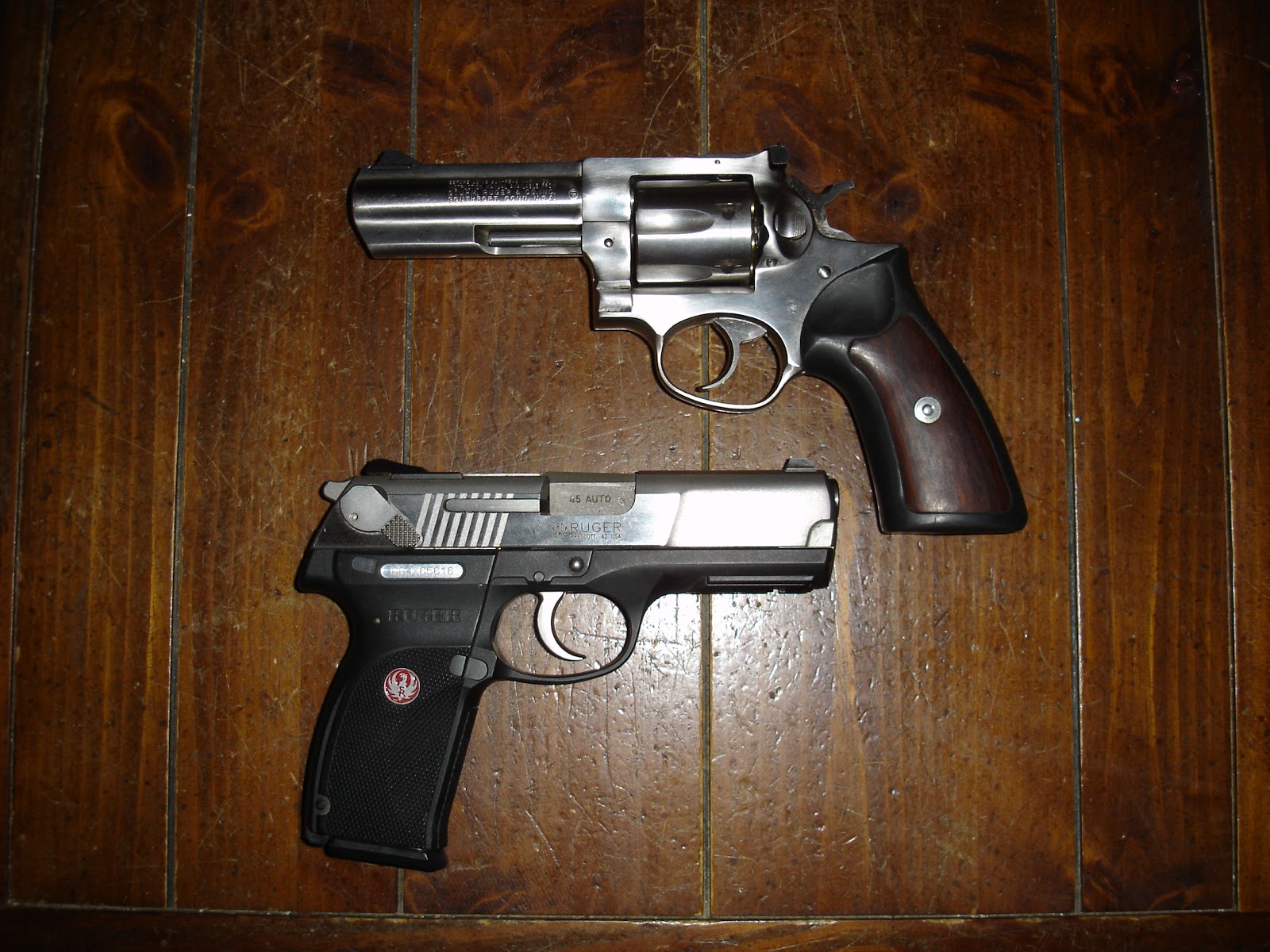
So here's the question - which gun? The revolver is a .357 and the pistol a .45. Both'll get the job done. I'm maybe a slightly better shot with the .45 though at the distance I'd take a shot in the woods here it really won't matter.

Any opinions?